
California has a serious housing shortage. The median price of a single-family home here has topped $800,000, and over half of all renters spend more than 30% of their income just on rent. (Source: California YIMBY)
So it pushed lawmakers to try something new: let housing get built on land that’s currently zoned for offices, retail stores, and parking lots — without the usual years-long approval fight.
That law is AB 2011. Here’s what it actually does, broken down without the legal jargon.
What Is AB 2011 (Assembly Bill 2011)?
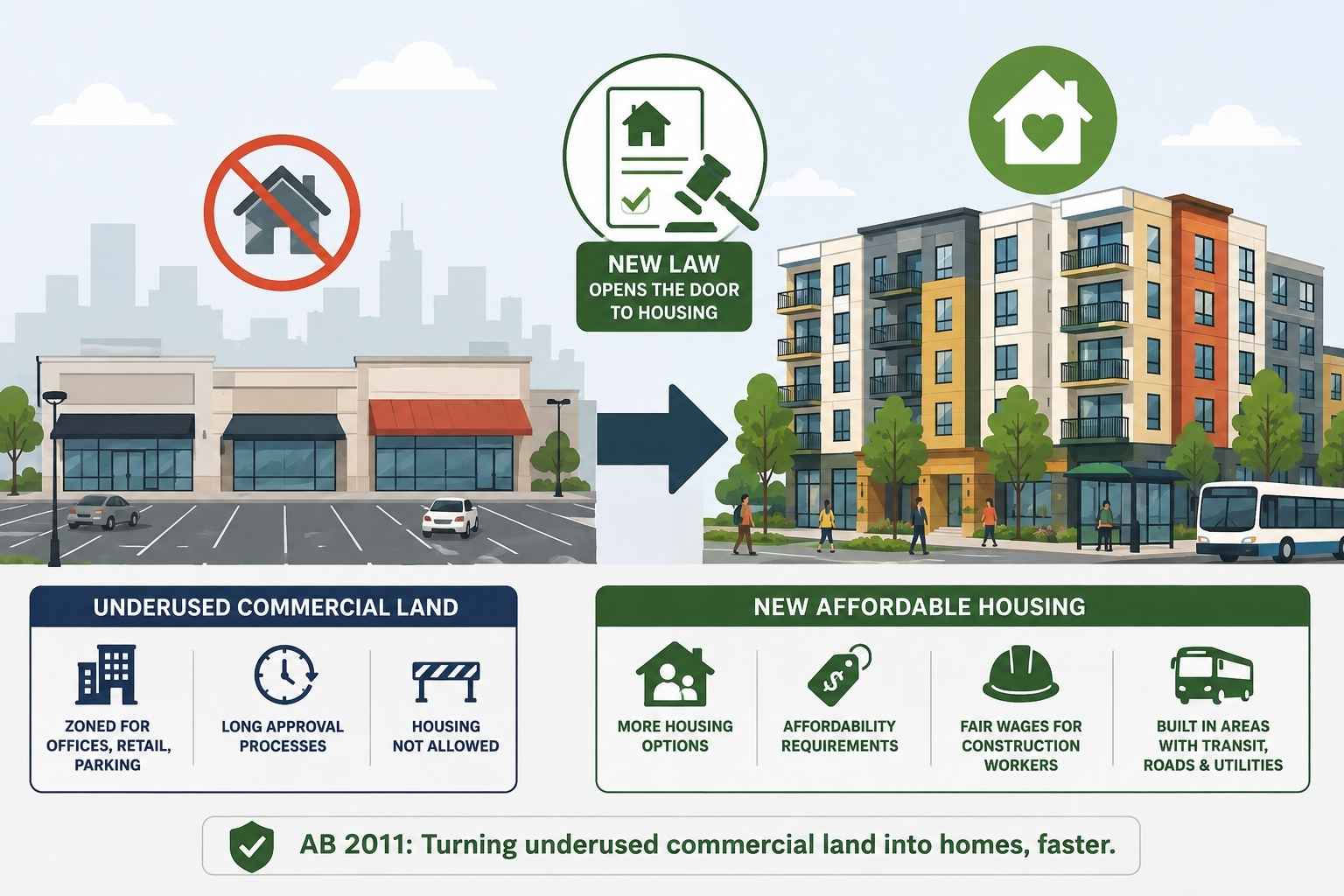
In one sentence: AB 2011 lets developers build apartment housing on commercially zoned land through a fast, “by right” approval process, as long as the project meets affordability and fair wage rules.
Professionally speaking, AB 2011 is best understood as a targeted rezoning tool. Rather than asking every city to rewrite its general plan or zoning code, the state stepped in and pre-approved a specific use, housing, on a specific category of land, commercial parcels, as long as a project meets the state’s own conditions. This approach lets the law apply uniformly across California’s cities and counties without waiting on hundreds of individual local policy changes.
| Full name | Affordable Housing and High Road Jobs Act of 2022 |
| Authored by | Assemblymember Buffy Wicks |
| Signed into law | September 28, 2022, by Governor Gavin Newsom |
| Took effect | July 1, 2023 |
| In effect until | At least January 1, 2033 |
| Last major update | AB 2243, effective January 1, 2025 |
You can read the full, official bill text on the California Legislative Information website.
Also Read: Variance vs. Conditional Use Permit vs. Rezoning
Why Was This Law Created?
California’s median home price and rents have made housing unaffordable for a large share of the state’s renters and buyers. Lawmakers looked at commercial corridors, meaning strips of land already zoned for offices, retail, or parking, and realized these sites are usually well served by roads, utilities, and sometimes transit, but they sit legally off limits to housing.
AB 2011 opens that land up, in exchange for guarantees on affordability and fair pay for construction workers. According to California YIMBY’s summary of the bill, one analysis found the potential for 2.4 million housing units statewide if this land were unlocked.
The Two Ways to Qualify
AB 2011 is not one size fits all. There are two separate tracks, and each has its own rules for where it applies and how much affordable housing is required.
| 100% Affordable Housing | Mixed-Income Housing | |
| Who it’s for | Projects where every unit is affordable | Mostly market-rate projects with some affordable units included |
| Where it’s allowed | Any qualifying commercial zone | Only on “commercial corridors,” a narrower category defined in the law |
| Minimum size | 5 or more units | 5 or more units |
A qualifying site, under both tracks, is generally one where office, retail, or parking is the “principally permitted use,” meaning that use is allowed to occupy more than one third of the site’s square footage without needing a special permit.
If you’re unfamiliar with how California zoning categories work in general, our guide to zoning and its types breaks down the basics.
Affordability Requirements
This is the part people get wrong most often, so here it is straight from the source rules:
| Project Type | Requirement | Deed Restriction |
| 100% Affordable | All units affordable to lower-income households | 55 yrs (rental) / 45 yrs (ownership) |
| Mixed-Income, Rental | Either 8% Very Low + 5% Extremely Low income units, or 15% Low income units | 55 years |
| Mixed-Income, Ownership | Either 30% Moderate income units, or 15% Low income units | 45 years |
Note: If a city’s own inclusionary housing ordinance requires a higher percentage of affordable units than AB 2011 does, the stricter local requirement applies instead.
These figures are confirmed by both the National Low Income Housing Coalition’s summary of AB 2011 and the LA City Planning page.
Labor Rules: Why It’s Called the “High Road Jobs Act”
The second half of AB 2011’s name is not decorative. Fast approval is directly tied to how construction workers on the project are treated and paid.
- Every project approved under AB 2011 must pay construction workers prevailing wage, meaning the standard wage rate set for that trade and region.
- Projects with 50 or more units must also provide healthcare benefits to workers and follow apprenticeship program participation rules.
- Contractors are required to request apprentices from an approved state program, but a lack of available apprentices does not stop the project from moving forward.
One detail worth knowing: AB 2011 does not require a “skilled and trained workforce,” which is a stricter, typically union-affiliated labor standard used in some other housing bills.
Building Standards: Height and Density
Where a project qualifies, the state sets a minimum standard the city has to allow. Cities remain free to allow more than this minimum, but they cannot legally require less.
Height, whichever is greatest, applies:
- The local height limit, or
- 65 feet, for sites within half a mile of a major transit stop, in cities with a population over 100,000, and not located in the coastal zone
- 45 feet, for sites on a commercial corridor that is 100 feet or wider
- 35 feet, for sites on a commercial corridor narrower than 100 feet
Density, in metropolitan areas, whichever is greatest applies:
- 40 units per acre, on a corridor under 100 feet wide
- 60 units per acre, on a corridor 100 feet or wider
- 80 units per acre, within half a mile of a major transit stop
What Makes Approval “Fast”: No CEQA, No Local Hearing
This is really the core mechanism of the law. AB 2011 uses a legal term called “ministerial approval.” In plain terms, ministerial means automatic: if a project meets the objective, written standards, the city is legally required to approve it. There is no public hearing where neighbors or council members can vote the project down, and no discretionary review process.
Two specific exemptions make this possible:
- No CEQA review is required. CEQA is the California Environmental Quality Act, and it is often the single biggest source of delay and litigation risk for housing projects. Qualifying AB 2011 projects are exempt from it.
- No conditional use permit or discretionary hearing is required. Approval happens at the staff level, based on a checklist of objective standards, not a vote.
Importantly, this applies automatically statewide. A city does not need to pass its own local ordinance for AB 2011 to take effect within its borders. A city may choose to adopt an implementing ordinance for its own administrative clarity, but that is optional, not a requirement for the law to apply. This distinction matters, since it is easy to assume a state housing law only works where a city has separately adopted it, and that is not the case here.
AB 2011 vs. SB 6: Don’t Mix These Up
AB 2011 and SB 6 (the Middle Class Housing Act of 2022) were signed by the governor on the same day and are often confused with each other. They are companion bills, not the same law.
| AB 2011 | SB 6 | |
| CEQA exempt | Yes | No |
| Affordable units required | Yes, per the table above | Not required by the bill itself |
| Labor standard | Prevailing wage plus apprenticeship and healthcare rules for larger projects | Prevailing wage plus a “skilled and trained workforce” requirement |
| Mixed-use requirement | Site eligibility based on existing commercial zoning | At least 50% of project square footage must be residential |
What Changed With AB 2243 (Effective January 1, 2025)
A few years into implementation, lawmakers passed AB 2243 to clarify and tighten parts of AB 2011. The most important changes:
- Confirmed that AB 2011 approval is ministerial regardless of what a local zoning ordinance would otherwise require, including conditional use permits or CEQA review, closing a loophole some cities were trying to use.
- Clarified that the law does not apply to sites where more than one third of the square footage is dedicated to industrial use, including certain currently vacant industrial sites.
- Refined several mixed-income project standards to close ambiguity in the original bill text.
For a full legal breakdown of these amendments, see the Allen Matkins 2025 legal alert on AB 2011 amendments.
What This Means for Homeowners
- AB 2011 targets commercial land, not existing single-family residential neighborhoods — it does not rezone your house or block.
- It can change what gets built near you — an old strip mall or office building down the street could become an apartment building without a public hearing you can attend to object.
- Neighborhood character and density near commercial corridors may shift over time as these sites get redeveloped.
What This Means for Builders & Developers
- A real path to skip CEQA litigation risk and discretionary hearings — historically two of the biggest sources of delay and cost.
- Requires careful upfront compliance: affordability %, prevailing wage documentation, and (for 50+ unit projects) healthcare/apprenticeship compliance.
- If the site has existing commercial tenants, you must notify them and provide relocation assistance to eligible tenants before proceeding.
- Height/density minimums make previously “too small to pencil” commercial lots viable for multifamily housing.
Conclusion
AB 2011 gives California a real, working shortcut for new housing: build on underused commercial land, meet the affordability and wage rules, and skip the CEQA review and public hearing fight. For homeowners, it means old strip malls and office parks nearby could become apartments faster than before. For builders, it’s one of the clearest by-right paths to multifamily housing the state has offered in years, as long as every requirement is met exactly.
Getting the details right, from affordability percentages to labor documentation, is what determines whether a project actually qualifies. If you’re planning a project under AB 2011 and want it handled correctly from day one, Strom Entitlement Permitting PM can help you navigate the process.
Quick FAQ
Does every city in California have to allow AB 2011 projects?
Yes. It applies statewide automatically. A city does not need to adopt its own ordinance for the law to take effect locally.
Can a city simply say no to a qualifying project?
No. If a project meets the written, objective standards, approval is ministerial. There is no discretionary vote or hearing where a city can deny it.
Is AB 2011 the same law as SB 6?
No. They are companion bills passed on the same day, but they differ on CEQA exemption, affordability requirements, and labor standards, as shown in the comparison table above.
Does AB 2011 apply to industrial land?
No. Sites where more than one third of the square footage is dedicated to industrial use are excluded, a point clarified by AB 2243.
How long will AB 2011 remain in effect?
At least until January 1, 2033, unless the legislature extends it before then.