

A Conditional Use Permit (CUP) in California is a discretionary land use entitlement that grants property owners the legal authority to use their property in ways not automatically permitted under existing zoning classifications.
This comprehensive guide draws on California state law, municipal codes, and established planning practices to explain what a CUP is, the statutory framework governing its approval, and the process you must follow to secure authorization.
What is a CUP in California?

A Conditional Use Permit authorizes specific land uses that require individual review and approval by local planning authorities. Unlike permitted uses that comply automatically with zoning designations, CUPs are discretionary approvals granted only when the proposed use satisfies conditions designed to protect community health, safety, and welfare.
According to California Government Code Section 65901, cities and counties possess the authority to establish procedures for conditional use permits as part of their zoning regulations. The permit becomes a property right that runs with the land, transferring automatically to subsequent owners subject to the original conditions of approval.
Key Evaluation Criteria
Planning commissions evaluate CUP applications based on established findings required under municipal codes. These typically include:
Location and Site Characteristics
- Property context within the surrounding neighborhood
- Proximity to sensitive uses (schools, residential areas, public facilities)
Project Design and Configuration
- Site layout, building design, and operational flow
- Architectural compatibility with existing development
Community Impact Analysis
- Environmental effects (assessed under CEQA)
- Traffic generation and circulation patterns
- Noise, odor, and other nuisance factors
- Public safety considerations
- Infrastructure capacity and adequacy
Operational Parameters
- Hours of operation
- Intensity and scale of activities
- Employee and customer volumes
CUP applications typically require a public hearing before a planning commission where the planner assigned by the city presents evidence supporting required findings and the applicant is asked to respond to questions from commissioners and affected community members. This hearing is a legal proceeding, not merely an informational meeting; testimony becomes part of the administrative record.
State Laws That Govern CUP Decisions in California

CUP approvals must comply with California state law and local regulations. Planning commissioners and staff operate within a defined legal framework that shapes every decision.
1. California Environmental Quality Act (CEQA)
CEQA frequently determines CUP outcomes. Under Public Resources Code Section 21000 et seq., all discretionary projects require environmental review to identify potential environmental impacts.
CUP projects undergo environmental analysis through:
- Many infill projects are allowed a Categorical Exemption, where where NO environmental review such as an EIR, MND, or ND are required
- If a Categorical Exemption cannot be used for a project, then typically a Negative Declaration (ND) if first sought after. However, if the project has impacts, but these impacts can be mitigated, then a Mitigated Negative Declaration (MND) can be used.
- An Environmental Impact Report (EIR) is typically used for projects with potentially significant environmental impacts that cannot be mitigated. Then a Statement of Overriding Consideration is used to state that the benefits to the community outweigh the impacts.
CEQA review evaluates:
- Air quality impacts
- Water quality and hydrology
- Noise and vibration
- Traffic and transportation
- Biological resources (sensitive habitats, protected species)
- Cultural and tribal resources
- Cumulative effects on long-term environmental health
2. General Plan Consistency
California planning law mandates that all land use decisions, including CUPs, must be consistent with the jurisdiction’s adopted General Plan (Government Code Section 65860). The General Plan serves as the community’s long-range blueprint, establishing policies for land use, circulation, housing, conservation, open space, safety, and noise.
3. Zoning Code Compliance
Local zoning ordinances establish the specific standards and procedures for CUP applications. Municipal codes typically specify:
- Permitted and conditional uses within each zoning district
- Development standards (setbacks, height limits, lot coverage)
- Parking and loading requirements
- Performance standards (noise limits, hours of operation)
- Design guidelines and architectural standards
- ADA accessibility compliance
- Public health and safety regulations
Zoning codes also define the findings required for CUP approval. For example, many jurisdictions require findings that the “use” will not be detrimental to public health or safety, will not adversely affect surrounding properties, and will comply with all applicable regulations.
How CUP Requirements Differ Between California Counties
While California planning law provides the statutory foundation, individual counties implement their own procedures, timelines, and review processes. These variations significantly affect application complexity and approval timelines. Understanding county-level differences is particularly important since California’s 58 counties oversee CUP applications for unincorporated areas within each county. Unincorporated areas of a county are the portions of each county that are NOT within an incorporated city.
Major County Comparison
California’s most populous counties demonstrate substantial procedural variations:
Important Note (Unincorporated Areas Only): The information in this table applies only to unincorporated county areas, which are the portions of each county that are NOT within an incorporated city. Counties in California only have CUP jurisdiction over these unincorporated areas. However, if your project is located within a city, you must contact that city’s planning department directly for the CUP applicable requirements.
| County | Key Process Features | Notification Radius | Decision-Making Body | Processing Timeline |
|---|---|---|---|---|
| Los Angeles County |
| 500 feet for surrounding property owners and occupants | Regional Planning Commission | 2-4 months for standard applications; 4-12 months with Environmental Impact Reports |
| San Diego County |
| 300 feet standard; extended for wireless facilities and certain uses | Planning Commission or Hearing Officer (based on project scope) | 3-6 months standard; expedited track available for qualifying projects |
| Orange County |
| 300 feet for property owners | Planning Commission | 60-90 days for minor CUPs; 4-6 months for major projects |
| San Bernardino County |
| 300 feet for standard projects; 500 feet for projects in sensitive areas or requiring environmental review | Planning Commission | 90-180 days for standard applications; 6-12 months for projects requiring Environmental Impact Reports |
| Riverside County |
| Varies by project type and location | Planning Commission | 60-120 days, depending on environmental review requirements |
These county-level differences underscore the importance of understanding local requirements before initiating the CUP process. What constitutes a complete application in one county may be insufficient in another. Applicants operating across multiple counties must adapt their approach to each jurisdiction’s specific procedures, submittal requirements, and review standards.
The California CUP Process: Step-by-Step
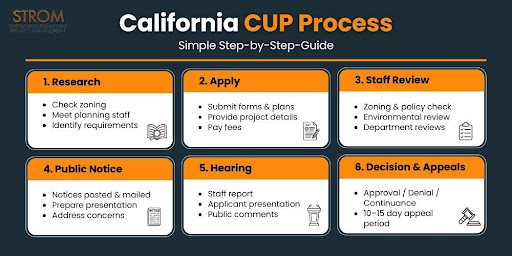
Successfully navigating the CUP process requires systematic preparation and attention to procedural requirements.
Step 1: Preliminary Research and Feasibility Analysis
Before investing time and money in a formal application, conduct thorough due diligence:
Zoning Verification
- Review the city or county zoning map to confirm your property’s zoning designation
- Examine the zoning code to determine whether your proposed use requires a CUP
- Identify specific CUP requirements and approval findings
Jurisdictional Consultation
- Schedule a pre-application meeting with planning staff
- Discuss your proposed use and potential issues
- Obtain application forms, submittal requirements, and fee schedules
- Request information on timelines and hearing schedules
This preliminary research identifies potential obstacles early so you can modify your project as necessary. Additionally, it helps you determine if the project is feasible as designed.
Step 2: Application Preparation and Submittal
CUP applications require comprehensive documentation. Incomplete applications result in delays or potentially rejection and resubmittal of the application.
Required Materials Typically Include:
- Completed application forms with all required signatures
- Property ownership documentation
- Detailed site plans showing existing and proposed improvements
- Building elevations and floor plans
- Parking and circulation diagrams
- Landscape plans
- Operational statements describing activities, hours, and intensity
- Environmental assessment documents
- Photographs of the site and the surrounding area
- Copies of relevant permits and approvals
- Stormwater Requirements, i.e., SWQMP (Stormwater Quality Management Plan)
- Grading and Drainage plans
- Drainage Study
Written Statements Must Address:
- How the proposed use satisfies each required finding
- Mitigation measures for identified impacts
- Compliance with zoning standards and General Plan policies
- Benefits to the community
Submit the complete application package with all required fees. Planning staff will review for completeness before accepting the application and initiating formal review.
Step 3: Staff Review and Environmental Analysis
Once deemed complete, your application enters the review phase:
- Planning staff analyzes the proposal against zoning standards and General Plan policies
- Environmental review proceeds under CEQA guidelines
- Other departments (public works/engineering, fire, building, health, landscaping) review for compliance with their respective regulations
- Staff prepares a report with findings and recommendations for the planning commission
This review period varies by jurisdiction and project complexity, with the first review typically taking at least one month. Then, typically, two or more city reviews are required.
Step 4: Public Notice and Hearing Preparation
California law requires public notice before CUP hearings:
- Posted notice on the property
- Mailed notice to property owners within a specified radius (typically 300-500 feet)
The notice period (usually 10-20 days) allows interested parties to review the proposal and prepare comments.
Use this period strategically:
- Meet with neighbors to address concerns
- Refine your presentation materials
- Prepare responses to anticipated questions
- Consider modifications that address potential objections
Step 5: Planning Commission Public Hearing
The public hearing is your opportunity to present your project to the Planning commissioners.
Typical Public Hearing Process:
- Staff presents its report and recommendation
- Applicant presents the project (typically 10-15 minutes)
- Commissions ask questions of the applicant
- Public comments (supporters and opponents)
- Applicant rebuttal
- Commission deliberation
- Commission action (approval, denial, or continuance)
Prepare a clear, professional presentation supported by visual materials. Address required findings explicitly and respond directly to concerns raised during public comment.
Step 6: Decision and Appeals
Following deliberation, the planning commission issues a decision:
- Approval: CUP granted with conditions
- Denial: Application rejected with findings explaining the basis for denial
- Continuance: Hearing postponed to allow for additional information or revisions
Decisions typically become final after a 10-15 day appeal period. Applicants or affected parties may appeal denials or approvals to the city council.
Common Reasons for CUP Approval or Denial
Understanding the factors that influence commission decisions helps applicants strengthen their proposals.
Approval Factors
Strong Applications Demonstrate:
- Full compliance with CEQA requirements, including comprehensive environmental analysis and effective mitigation measures
- Clear consistency with General Plan policies and zoning standards
- Compatibility with surrounding land uses through appropriate design, screening, and operational controls
- Community benefits such as job creation, service provision, or neighborhood improvements
- Proactive engagement with neighbors and stakeholders
- Professional presentation with complete, well-organized materials
Denial Triggers
Applications Fail When They:
- Submit incomplete applications lacking required plans, studies, or documentation
- Create unmitigated environmental impacts or fail to adequately address CEQA requirements
- Conflict with General Plan policies or zoning standards
- Generate significant community opposition based on legitimate land use concerns
- Pose demonstrable risks to public health, safety, or welfare
- Fail to provide credible evidence supporting required findings
- Present inadequate responses to identified issues or concerns
Costs and Timelines in California
CUP processing involves both time and financial investment. Costs and timelines vary significantly by jurisdiction and project complexity.
Typical Approximate Timelines, understanding that some jurisdictions may require more time.
| Simple projects | 120 to 180 days +/- from complete application to hearing |
|---|---|
| Projects requiring environmental review | (ND or MND) 6-12 months +/- |
| Complex projects with EIRs | 12 to 18 months +/- |
Application Fees
CUP fees vary by jurisdiction and typically cover:
- Application processing
- Environmental review (initial study, negative declaration, or EIR)
- Public notice and hearing costs
- Staff time for report preparation
CUP fees from the city or county are typically non-refundable, even if the application is denied. Budget accordingly and ensure your application is strong before submitting.
Other potential costs associated with a CUP
- Technical Studies (i.e., Noise, Traffic, Air Quality, Biological, etc.)
- Architectural Plans
- Grading and Drainage Plans
- SWQMP (Storm Water Management Plan)
- Drainage Study
- Initial Study for CEQA for ND, MND, or EIR is required
How the Strom Entitlement Permitting PM Facilitates CUP Approval
The variation in requirements across California’s 482 cities and 58 counties creates complexity that challenges even experienced developers. Relying on internet research or informal phone inquiries often leads to incomplete applications, processing delays, and preventable denials.
Strom Entitlement Permitting PM provides professional land use entitlement services across California.
Our Comprehensive Services Include:
Due Diligence and Feasibility Analysis
- Zoning verification and code research
- General Plan consistency review
- Preliminary environmental screening
- Identification of potential obstacles
Application Management
- Complete application preparation
- Coordination with technical consultants (environmental, traffic, biological, etc.)
- Coordination with city and county staff
- Coordination with state and federal agencies (i.e., Army Corps, Fish and Wildlife, etc.)
- Coordination with utility agencies such as water, sewer, electricity, and natural gas.
- Submittal management and staff coordination
- Response to staff comments and correction requests
- Communication with city, county, utility agencies, state, and federal staff regarding clarification and negotiation of requirements
- Compile and submit the initial submittal and all subsequent submittals needed for approval
Approval Strategy and Advocacy
- Presentation development for planning commission hearings
- Stakeholder engagement and community outreach
- Strategic project modifications to address concerns
- Hearing representation
Post-Approval Coordination
- Condition compliance monitoring
- Permit issuance coordination
Take the Next Step
If you’re ready to advance your project, contact Strom Entitlement Permitting PM for a complimentary 20-minute consultation. Our land use professionals will assess your situation, identify the path to approval, and explain how we can streamline the CUP process for your specific project.
Don’t let incomplete knowledge or procedural missteps derail your development plans. Partner with professionals who understand land use regulations and can navigate the governmental system effectively.