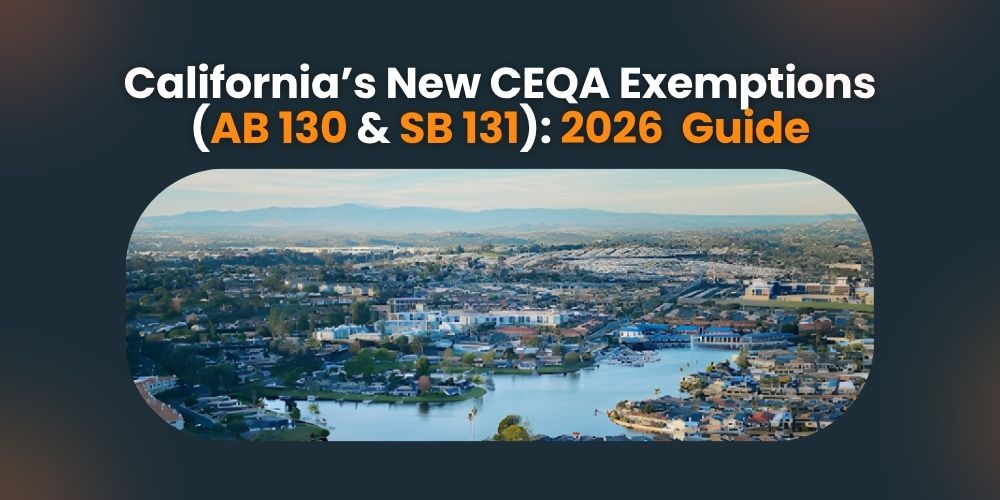
CEQA has a reputation for slowing projects down, draining budgets, and complicating even the most straightforward development plans. But with California’s new 2026 CEQA exemptions, that might finally be changing.
AB 130 and SB 131 introduce faster pathways for infill housing and public infrastructure, offering developers a chance to move projects forward with fewer delays, less paperwork, and clearer expectations. But before we get into the new laws, it’s worth knowing that a key exemption, the Categorical Exemption, already exists and is the most commonly used tool by permit consultants for infill development. This guide covers all three, so you know exactly which path fits your project.
What Is CEQA? A Quick Background

The California Environmental Quality Act, or CEQA, as it’s known, requires agencies at the state and local level to let the public and decision makers know about any potential environmental impact resulting from a project or business operations in their area.
The prime goal is to minimize those effects as much as possible. While this goal might seem like a win-win for all parties involved, it does pose a challenge if you’re looking to develop a piece of land.
In some cases, projects have been severely delayed, thus driving up the cost. And for this reason, you might explore the California CEQA exemptions that have come about as a result of recent legislation.
Overview of the New 2026 CEQA Exemptions
To address housing shortages and infrastructure needs, California lawmakers have passed new exemptions to CEQA. The rationale behind the changes relates to streamlining the approval process for certain project types.
Ultimately, the goal is to accelerate housing and critical infrastructure development while maintaining environmental safeguards for sensitive projects. Hence, you might see shorter timelines and a simpler pathway towards getting your permits.
| Exemption | What It Covers |
| AB 130 | Exempts qualifying infill housing projects in urban and suburban areas from full CEQA review, helping developers move faster on residential development. |
| SB 131 | Exempts public infrastructure projects such as transit, water, and energy facilities from CEQA review when they demonstrate a clear public benefit. |
Hence, you might see shorter timelines and a simpler pathway towards getting your permits. But first, let’s look at the exemption permit consultants rely on most: the Categorical Exemption.
Understanding Categorical Exemptions: The Foundation You Need to Know First
Before diving into the new 2026 legislation, it’s essential to understand the most widely used CEQA exemption in practice: the Categorical Exemption. For permit consultants and developers working on infill projects, this is typically the first tool to evaluate, as it can provide the fastest and most straightforward path to project approval.
What Is a Categorical Exemption?
A Categorical Exemption allows certain classes of projects to bypass CEQA environmental review entirely, without requiring an Environmental Impact Report (EIR) or a Negative Declaration. The State of California has pre-determined that these project categories cause little to no significant environmental harm under normal circumstances.
Unlike AB 130 or SB 131, Categorical Exemptions are not new legislation. They are existing, established CEQA tools codified in the California Code of Regulations (CCR), Title 14, Sections 15300–15333. They are commonly used, legally tested, and well understood by local agencies, making them a reliable first option for many infill development projects.
Class 32: The Infill Exemption (Most Relevant for Developers)
For infill housing and mixed-use development, Class 32 is the most important Categorical Exemption. It was specifically designed to streamline approvals for urban infill projects that meet defined criteria.
Class 32 Categorical Exemption: Eligibility Criteria at a Glance
To qualify, a project must meet ALL of the following conditions:
- The project is consistent with the applicable General Plan designation and all applicable General Plan policies, as well as applicable zoning designation and regulations.
- The proposed development occurs within city limits on a project site of no more than 5 acres substantially surrounded by urban uses.
- The project site has no value as habitat for endangered, rare, or threatened species.
- Approval of the project would not result in any significant effects relating to traffic, noise, air quality, or water quality.
- The site can be adequately served by all required utilities and public services.
If your project checks all five boxes, you can file a Notice of Exemption (NOE) with the county clerk and the State Clearinghouse and proceed to permitting without further CEQA review. This is why permit consultants rely on Class 32 as their go-to exemption for infill work.
Other Commonly Used Categorical Exemptions
While Class 32 is the primary tool for infill development, other categories may also apply depending on your project scope:
- Class 1 (Existing Facilities): Minor alterations or additions to existing structures.
- Class 3 (New Construction): Small structures such as duplexes, small commercial buildings under 10,000 sq ft, or accessory structures.
- Class 15 (Minor Land Divisions): Dividing land into four or fewer parcels in urbanized areas.
Categorical Exemption vs. AB 130 / SB 131: How They Relate
Think of it this way: Categorical Exemptions (especially Class 32) are your first line of defense. If your infill project qualifies, this is the fastest route with no new legislation required, and local agencies are already familiar with the process.
AB 130 and SB 131 (explained in detail below) expand on this by creating additional statutory exemptions for projects that may not meet the strict Class 32 criteria, particularly larger sites, suburban infill, or public infrastructure. They work alongside Categorical Exemptions, not in place of them.
| Categorical Exemption (Class 32) | AB 130 / SB 131 (New 2026 Legislation) |
| Pre-existing CEQA tool (well-established) | New statutory exemptions effective Jan 1, 2026 |
| Site must be 5 acres or less | Allows up to 20 acres |
| Urban infill only (within city limits) | Covers urban and suburban areas |
| Fastest route when all 5 criteria are met | Broader eligibility, but more documentation |
| No public benefit requirement needed | AB 130 favors affordable/mixed-income housing |
| Private and public projects eligible | SB 131 is limited to public infrastructure only |
AB 130 Explained: Infill Housing CEQA Exemptions
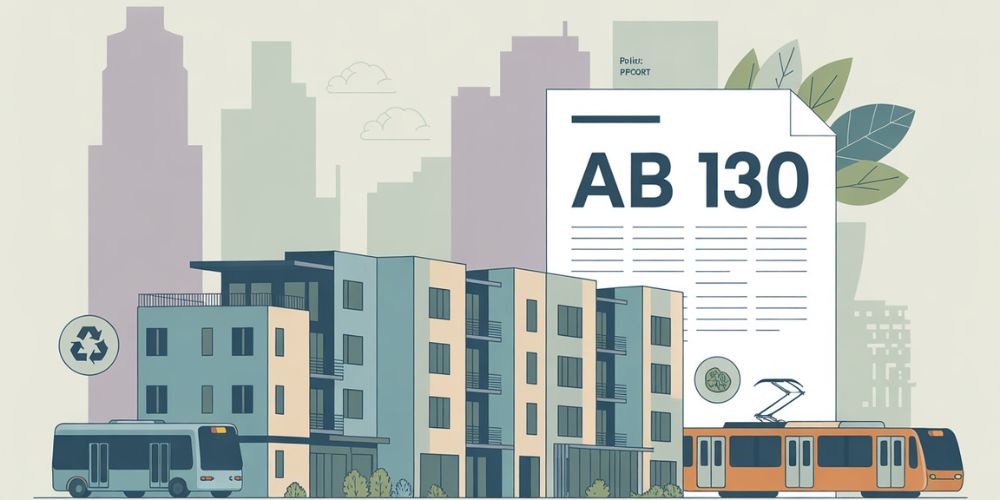
AB 130, which was passed in June of 2025, primarily pertains to housing developments located in urban areas that are surrounded by established infrastructure and in close proximity to transit. At the same time, it does address suburban areas as well.
Basically, your residential project must meet the following criteria:
- minimum density requirements – 10 units per acre in suburban areas; 15 units per acre in urban areas
- proximity to public transportation – this comes in the form of mitigation fees as opposed to specifying distance
- adherence to local zoning and general plan standards
The exemption process involves submitting your application, outlining your project’s compliance with specific thresholds (ie: high-risk environmental zones), and giving proof that your project fits the legal infill criteria.
Ideally, AB 130 is meant to encourage affordable and mixed-income housing, with additional benefits for projects that incorporate eco-friendly building practices or serve low-income populations.
The exemption, however, does not apply to projects in environmentally sensitive areas, such as wetlands or the habitats of protected species. And you may have to rethink developing property in an area that’s considered to be “historically significant.”
SB 131 Explained: Infrastructure & Public Project Exemptions
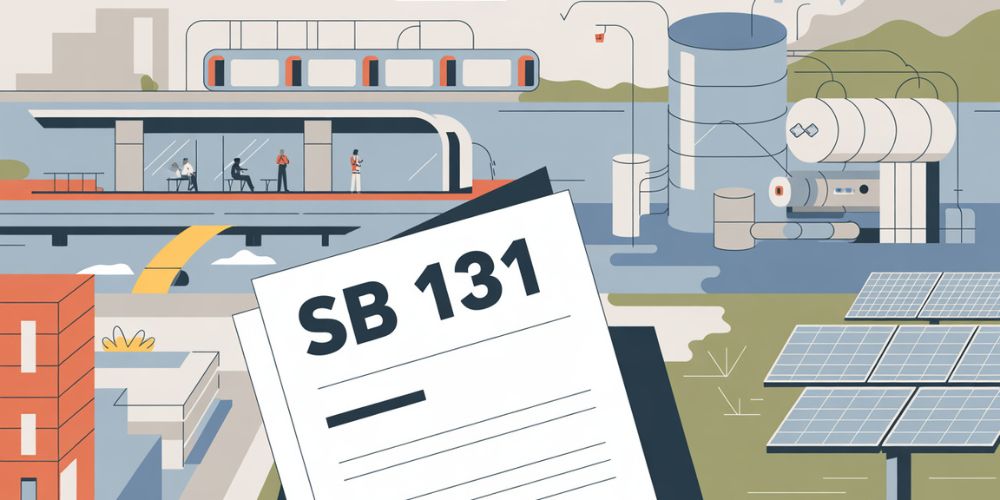
SB 131 goes hand-in-hand with AB130 by focusing on public infrastructure improvements, such as:
- transit upgrades
- water systems
- facilities that provide electricity and other energy sources.
For your project to be eligible for this exemption, your plan must demonstrate a clear benefit for the local population. It also has to comply with local and state regulations and avoid significant impacts on vulnerable habitats or other sensitive resources.
The qualifying process involves detailing the project’s public purpose, submitting technical documentation, and confirming compliance with all relevant health and safety codes.
On the other hand, SB 131 differs from AB 130 since it does not extend to private residential or commercial developments. Instead, this exemption paves the way for the expedited delivery of essential infrastructure and public services.
Another caveat that you’ll need to remember is that any project that’s located in a high-risk environmental area or one that triggers a federal environmental review still requires additional scrutiny by the decision-making body.
AB 130 vs. SB 131: Key Differences
While both AB 130 and SB 131 streamline the CEQA process, their purposes greatly differ.
differ.
| AB 130 | SB 131 |
| Focuses on meeting requirements for infill housing in urban settings | Relates only to public infrastructure and projects that serve the overall community |
| Promotes the increase in affordable housing units | Prioritizes improvements to transportation access, utilities, and public facilities |
| Requirements place emphasis on housing density and affordability | Requirements center on the resilience of infrastructure and public ownership |
| Criteria also include access to public transit | Takes service delivery (ie, utilities) into account |
Who Qualifies for the 2026 CEQA Exemptions?
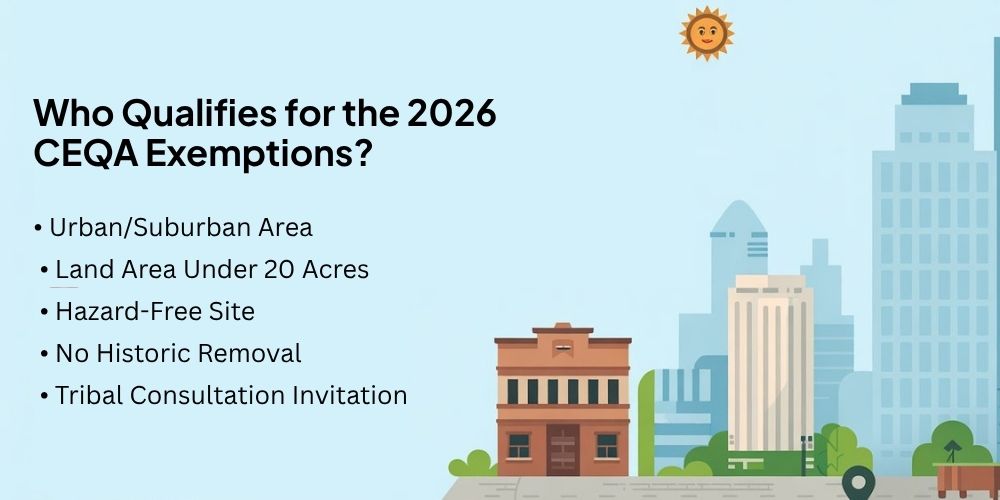
Depending on the purpose and scope of your project, you stand a chance of qualifying under these criteria:
- Your site is located in an urban or suburban area
- The land area comes to 20 acres or less
- Your site is free of hazardous substances
- You won’t have to request the removal of historic structures
- If applicable, you have a formal “invitation for consultation” with a Native American tribe
And there are other factors which you’ll need to explore further, such as infill and wage requirements.
At this point, you might wonder whether your project is eligible for the new exemptions–or even which one of the two laws directly relates to your plan. Those answers depend on the following:
- Your project type
- The location of your planned structure
- Your plan’s alignment with legislative intent
Thus, when in doubt, you might play it safe by contacting a consultant who specializes in permits to find out your eligibility and the next steps.
Required Documentation (Even When CEQA Is “Exempt”)
Although your project could qualify for AB 130 or SB 131 exemptions, you still need to have the proper documentation in place. The forms and information include:
- Project description and maps
- Evidence of meeting exemption criteria (e.g., infill status, public benefit)
- Technical studies confirming the absence of significant environmental impacts
- Notices of exemption filed with the relevant agency
- Public disclosure and recordkeeping for transparency
Missing any part of this documentation could not only affect your exemption status but also delay your project, thus costing more time and money. So consider keeping detailed records, keeping your stakeholders informed, and having a “Plan B” in place in case you run into obstacles.
CEQA Timelines Before vs. After the New Exemptions
Another important aspect of development, of course, is your project’s timespan. Thus, pursuing exemptions from CEQA might prove to be worth the effort when you compare the potential timelines after obtaining the exempt status.
atus.
| Traditional CEQA Review | 2026 Exemptions |
| Lengthy Environmental Impact Review. | Exempt projects move straight to permitting. |
| Longer wait time for reviews and receiving notice of approval. | More streamlined documentation if your project meets the exemption criteria. |
| The requirement for public notice remains. | The period for public input is shortened. |
How Developers Can Use These Exemptions in 2026
Most likely, you and many other developers might look at strong possibilities of a simpler qualifying process for gaining permits, or at least less waiting for a decision.
Nonetheless, as 2026 approaches, you can start now with gathering the necessary documentation and research. However, you can also shorten the complexity and process of gaining the permits you need.
Likewise, you can take some additional steps to increase your chances of success.
- Evaluate project eligibility early—assess location, type, and compliance with AB 130 or SB 131 criteria
- Engage with local agencies and legal counsel to confirm exemption status
- Prepare for public notice and disclosure steps, even if exempt
- Monitor legislative updates for changes or clarifications to exemption rules
How StormPermit Helps With CEQA Exemption Filing
Storm Permit offers technology-driven solutions for environmental permitting and CEQA compliance. For developers pursuing exemptions under AB 130 or SB 131, StormPermit can:
- Automate exemption eligibility screening based on project data
- Generate required documentation and notices of exemption
- Track deadlines and submission requirements to avoid delays
- Facilitate communication with regulatory agencies and stakeholders
- Maintain secure records for future audits or legal challenges
Leveraging StormPermit’s platform helps ensure a smooth, compliant, and efficient exemption filing process.
FAQs:
When do AB 130 & SB 131 take effect?
Both laws are scheduled to take effect on January 1, 2026, impacting all qualifying projects initiated after this date.
Are there exceptions where CEQA still applies?
Yes. Projects with significant environmental impacts, those located in sensitive resource areas, and those triggering federal review remain subject to CEQA, even if otherwise eligible for exemption.
Do infill projects get “automatic” exemptions?
No. Infill projects must meet specific criteria and submit supporting documentation to qualify; exemptions are not automatic.
Can these exemptions be challenged in court?
Yes. While the exemptions are designed to withstand legal scrutiny, opponents may challenge exemption determinations based on procedural errors or disputed eligibility. Thorough documentation and compliance are essential to defending exemption status.
Conclusion
The 2026 CEQA exemptions through AB 130 and SB 131 mark a pivotal shift in California’s approach to infill housing and public infrastructure development. By streamlining environmental review for qualifying projects, the state aims to address urgent housing and infrastructure needs while upholding core environmental protections. Developers, planners, and legal professionals should familiarize themselves with the new rules, invest in robust documentation, and leverage tools like StormPermit to ensure successful exemption filing. Staying informed and prepared will be crucial to capitalizing on these legislative changes in 2026 and beyond.