A property can look perfectly suitable for development until someone reviews what lies beneath the zoning designation.
In San Diego, a parcel may be zoned for residential or commercial use and still face significant development restrictions because of steep slopes, sensitive habitats, floodplains, coastal resources, or other environmental conditions.
These restrictions can change what an owner is permitted to build, where construction may occur, and which approvals must be secured before development begins.
One of the most important approvals to investigate is the Site Development Permit in San Diego, commonly called an SDP.
Unlike a routine ministerial approval, an SDP can involve discretionary review, environmental analysis, public decision-making, and specific findings concerning the proposed development.
For hillside property owners, architects, residential developers, and land acquisition teams, understanding whether an SDP is required can prevent costly mistakes.
A project that appears straightforward during preliminary design may become significantly more complicated once the city identifies environmentally sensitive lands on the property.
This guide explains when San Diego’s environmentally sensitive lands regulations can trigger an SDP, which property conditions deserve early investigation, how discretionary review works, and what to prepare before submitting a development application.
What Is a Site Development Permit in San Diego?
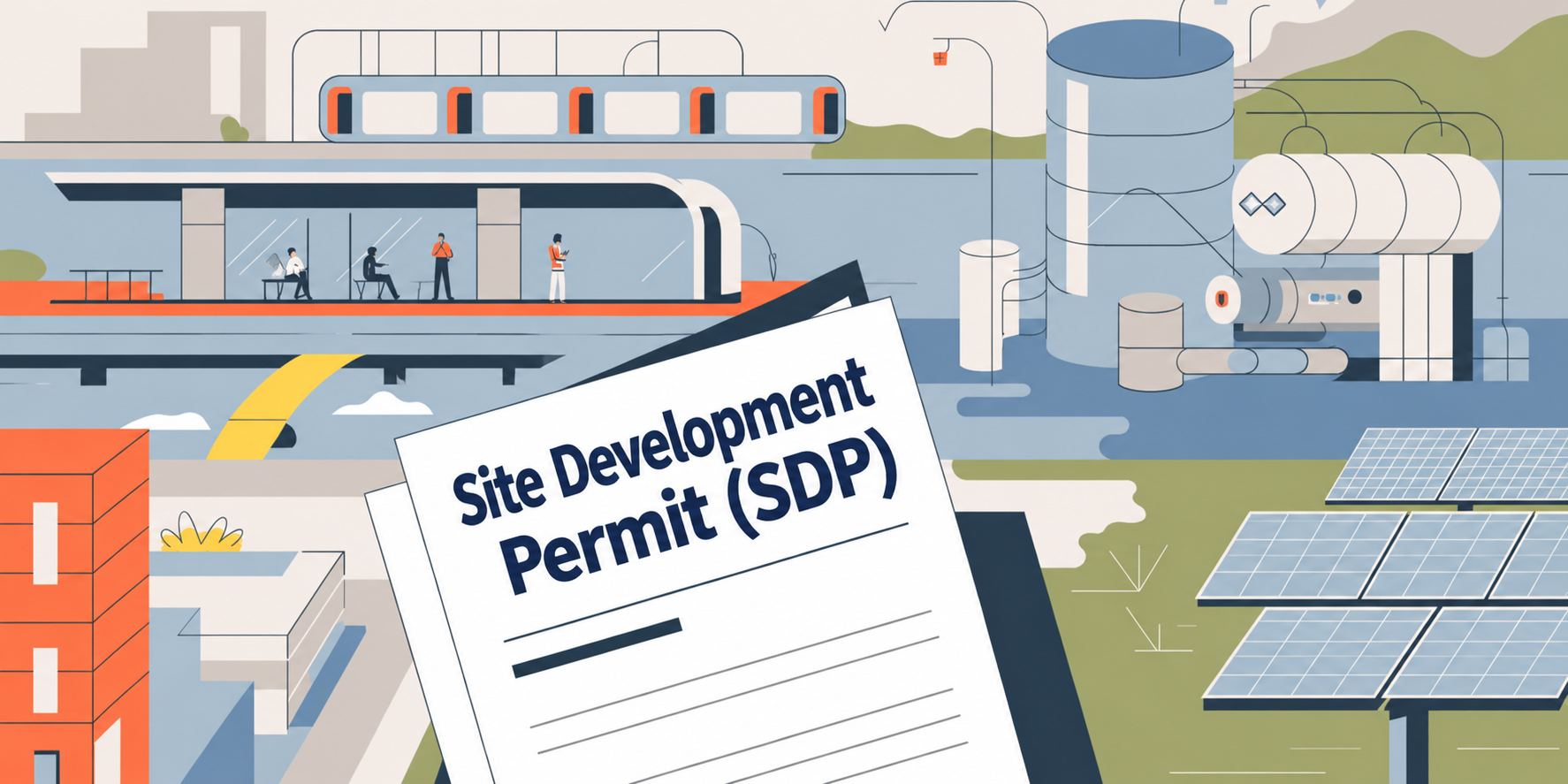
A Site Development Permit (SDP) is a discretionary land-use approval used by the City of San Diego for certain developments that require additional review under the San Diego Municipal Code.
For environmentally constrained properties, the SDP process allows the city to evaluate whether a proposed project satisfies applicable land development regulations and whether its design appropriately addresses protected resources.
The primary regulatory provisions include:
- San Diego Municipal Code Section 126.0501 and following, governing Site Development Permit procedures.
- Chapter 14, Article 3, Division 1, containing the Environmentally Sensitive Lands Regulations.
- Applicable discretionary review and decision-making procedures under Chapter 11.
An SDP does not replace zoning compliance, building regulations, or other applicable development approvals.
Instead, it addresses particular circumstances in which a project requires discretionary findings beyond ordinary administrative compliance.
Why Does an SDP Matter to Property Owners?
The most significant difference is the level of review.
A ministerial approval generally focuses on whether submitted plans satisfy objective requirements.
A discretionary SDP allows the reviewing authority to evaluate the project against applicable approval findings, including how the development affects environmentally sensitive lands.
This can influence building placement, grading, access, drainage, landscape protection, and environmental mitigation.
For developers, the SDP determination should therefore occur during feasibility, not after architectural drawings are substantially complete.
When Is a Site Development Permit Required in San Diego?
An SDP may be required when proposed development affects environmentally sensitive lands or falls within another category identified by the San Diego Municipal Code.
The presence of a protected resource is an important warning sign, but it does not automatically establish that every proposed activity requires an SDP.
The applicable permit requirement depends on the resource category, the nature and location of the proposed work, exemptions, and the city’s adopted regulations.
This preliminary screening helps identify conditions that deserve closer investigation. It does not substitute for the city’s formal interpretation of the applicable permit requirements.
A parcel may contain environmentally sensitive lands without the proposed development disturbing them. Conversely, a seemingly modest addition or grading proposal may affect a protected area and require more extensive review than anticipated.
The project’s location, design, and disturbance footprint are essential to the determination.
Which Environmentally Sensitive Lands Trigger Additional Review?
San Diego’s Environmentally Sensitive Lands Regulations, commonly called ESL regulations, identify several categories of protected or constrained land.
These include sensitive biological resources, steep hillsides, coastal beaches, sensitive coastal bluffs, and Special Flood Hazard Areas.
The applicable rules are found primarily in Municipal Code Sections 143.0101 through 143.0160.
Environmentally Sensitive Lands Permit Matrix
| Site condition | Why it matters | Potential review pathway |
| Steep hillsides | Natural slopes, grading, erosion, and landform alteration | NDP or SDP depending on project type and applicable standards |
| Sensitive biological resources | Habitat disturbance and resource protection | NDP or SDP; additional biological analysis may be needed |
| Sensitive coastal bluffs | Bluff stability, erosion, and coastal protection | SDP and potentially CDP |
| Coastal beaches | Coastal resource and public safety protections | SDP and potentially CDP |
| Special Flood Hazard Areas | Flood exposure, drainage, and development restrictions | ESL review; NDP or SDP as applicable |
| Multiple ESL categories | Overlapping development restrictions | Applicable requirements for each resource; higher decision process governs |
The regulations specify that when a development proposal affects multiple ESL categories, the applicable requirements must be considered together, and the higher required decision process applies.
1. Steep Hillsides: When Does a Hillside Project Need an SDP?
Hillside development is one of the most common situations in which San Diego property owners encounter unexpected permitting complexity.
A steep slope can affect building placement, driveway design, grading quantities, retaining structures, drainage, and the amount of land available for development.
San Diego’s ESL regulations generally identify steep hillsides using a natural slope gradient of at least 25%, subject to the detailed definitions and exclusions in the Municipal Code.
However, not every property with a steep slope automatically requires a Site Development Permit.
Under Section 126.0502, single-dwelling-unit development on a lot larger than 15,000 square feet containing steep hillsides can trigger Process Three SDP review.
The same provision addresses smaller lots held in contiguous ownership where the combined area exceeds 15,000 square feet.
Other project types, including multiple-unit residential development, may also trigger SDP review when environmentally sensitive lands are present.
A property owner researching a steep hillside permit San Diego should therefore examine both the site’s physical conditions and the proposed development type.
What Should Be Checked Before Designing on a Hillside?
A topographic survey is often the starting point.
The project team should identify natural slopes, proposed grading limits, building envelopes, access routes, and areas where retaining structures may be necessary.
Geotechnical conditions deserve equal attention.
Even where the proposed building footprint avoids the steepest portion of the parcel, grading, drainage improvements, or access construction could affect regulated areas.
A preliminary site plan that responds to the terrain can help avoid repeated redesign.
2. Sensitive Biological Resources: When Does Habitat Trigger an SDP?
San Diego contains areas of important biological habitat, including native vegetation communities and resources protected through regional conservation planning.
Properties containing sensitive biological resources may face restrictions on grading, vegetation removal, building placement, and other land-disturbing activities.
A sensitive biological resources development permit determination depends on the resource classification, the proposed work, and the applicable development regulations.
Projects should also be evaluated for consistency with the City’s Multiple Species Conservation Program Subarea Plan and, where applicable, its Vernal Pool Habitat Conservation Plan.
A property does not need to appear untouched to contain sensitive biological resources.
Vacant land surrounded by development may still support protected vegetation or habitat.
Similarly, a previously disturbed site may contain resources requiring investigation.
What Does a Biological Review Typically Examine?
Depending on the site, a qualified biological professional may need to assess vegetation communities, habitat boundaries, sensitive species, and the relationship between the proposed development and protected areas.
The findings can influence building location, grading limits, mitigation measures, and the overall feasibility of the proposal.
Early biological screening is particularly useful when purchasing vacant land or evaluating a substantial development footprint.
3. Coastal Bluffs and Coastal Beaches: Why Is Review More Complicated?
Coastal properties present a different set of development considerations.
A project near a sensitive coastal bluff may raise concerns involving erosion, geologic stability, public safety, and the preservation of coastal resources.
The City applies specific regulations to sensitive coastal bluffs and coastal beaches.
Section 126.0502 identifies single-dwelling-unit development on premises containing these resources as a potential SDP trigger.
A Coastal Development Permit may also be required when the project qualifies as coastal development within the Coastal Overlay Zone.
This means a property owner may need to investigate both an SDP and a CDP.
The two approvals address overlapping but distinct regulatory requirements.
4. Special Flood Hazard Areas: What Should Owners Investigate?
Properties located within regulated flood hazard areas may be subject to additional development standards and permit review.
Potential concerns include building elevation, drainage, floodwater movement, site access, and restrictions on certain improvements.
San Diego’s ESL framework includes Special Flood Hazard Areas, with coastal V zones addressed through the coastal beach category.
The precise review requirements depend on the mapped flood designation, proposed development, and applicable exemptions.
For a property owner, the first practical step is to confirm the site’s flood hazard classification and evaluate whether the proposed improvements affect regulated areas.
A zoning designation that permits the intended use does not eliminate flood-related development restrictions.
San Diego SDP Process Three vs. Process Four: What Is the Difference?
The City of San Diego uses different decision processes depending on the development category and the applicable Municipal Code requirements.
For environmentally sensitive lands, the distinction between Process Three and Process Four is especially important.
PROCESS THREEHearing OfficerGenerally applies to specified development on environmentally sensitive lands, including qualifying single-dwelling, multiple-unit residential, commercial, and industrial projects. | PROCESS FOURPlanning CommissionApplies to certain higher-level discretionary approvals, including subdivision of premises containing environmentally sensitive lands and deviations from ESL regulations. |
Actual processing depends on the current Municipal Code, project characteristics, exceptions, and any combined approvals.
The City’s September 2026 code identifies Process Three under Section 126.0502(a) for several development types involving environmentally sensitive lands.
It also expressly identifies subdivision of premises containing environmentally sensitive lands and development seeking deviations from ESL regulations as Process Four SDP categories.
docs.sandiego.gov
Does Every SDP Go Before the Planning Commission?
No.
Some SDP applications are decided through Process Three, generally involving a Hearing Officer decision. Others require Process Four, generally involving the Planning Commission.
The reviewing authority is determined by the applicable code provisions rather than the applicant’s preference.
There are also special processing provisions for certain affordable housing, infill, and sustainable building projects.
Under Section 126.0503, qualifying projects that would otherwise require specified SDPs may instead be eligible for a Neighborhood Development Permit through Process Two, provided the applicable findings can be made.
This is another reason to verify the exact permit pathway rather than assume every environmentally constrained project requires the same approval process.
Can a San Diego Project Require Both an SDP and a Coastal Development Permit?
Yes.
A project may require both a Site Development Permit and a Coastal Development Permit when it involves environmentally sensitive lands and also meets the applicable coastal permitting requirements.
For example, consider a proposed residential development on a coastal property containing a sensitive bluff.
The SDP analysis may address the project’s impacts on environmentally sensitive lands, landform alteration, and compliance with the relevant development regulations.
The CDP analysis may address the coastal development requirements applicable to the site.
Depending on the property and proposal, the project may also require geotechnical documentation or other technical studies.
Developers should not assume that obtaining one approval automatically satisfies the other.
The City’s ESL regulations expressly recognize the potential need for a CDP when coastal development occurs within the Coastal Overlay Zone.
docs.sandiego.gov
For coastal projects, the applicable Local Coastal Program provisions and the status of Coastal Commission certification of relevant amendments should also be checked.
What Findings Must Be Made Before an SDP Can Be Approved?
A discretionary permit is not simply a procedural requirement.
The decision-maker must be able to make the findings required by the Municipal Code.
Under Section 126.0505, the general SDP findings address whether the development:
- Will avoid adversely affecting the applicable land use plan.
- Will not be detrimental to public health, safety, and welfare.
- Will comply with the Land Development Code, including allowable deviations.
For projects involving environmentally sensitive lands, supplemental findings apply.
These address matters such as the physical suitability of the site, minimizing disturbance to protected resources, avoiding unnecessary alteration of natural landforms, and preventing adverse impacts on adjacent environmentally sensitive lands.
Consistency with applicable habitat conservation planning is also relevant.
Why Should These Findings Influence Early Design?
A project can encounter difficulties when its design does not provide enough evidence to support the required findings.
For example, a proposed hillside development may involve extensive grading even though a smaller building footprint could reduce disturbance.
Similarly, a development near protected habitat may require revisions to access arrangements or building placement.
Addressing these issues during preliminary design can make the discretionary review more manageable.
The objective should be to prepare a project that can demonstrate compliance, not merely submit a design and wait for objections.
What Documents Should Be Prepared Before an SDP Application?
A well-organized pre-submittal package can help identify potential issues before the project enters formal review.
The exact documentation depends on the property, development type, and the City’s current submission requirements.
However, several materials are commonly relevant.
Pre-Submittal Document Checklist
Project Preparation Tracker
- Property address, assessor’s parcel number, and ownership information
- Current zoning, community plan designation, and applicable overlays
- Boundary and topographic survey showing existing site conditions
- Preliminary site plan with building footprints, access, and grading limits
- Environmentally sensitive lands screening and relevant mapping
- Biological assessment when sensitive resources may be affected
- Geotechnical or slope stability information where applicable
- Flood hazard documentation where applicable
- Coastal development screening for properties within the Coastal Overlay Zone
- Preliminary explanation of applicable SDP findings
- Other technical reports identified through City review
- Copy Document Checklist
Not every project requires every document listed above.
For example, a biological assessment may be unnecessary if the City determines that sensitive biological resources are not implicated.
Likewise, coastal documentation may not apply to an inland property.
The purpose of early screening is to identify the appropriate studies rather than commission every possible report.
How Long Does a Site Development Permit Take in San Diego?
There is no single approval timeline that accurately represents every San Diego SDP application.
The duration depends on project complexity, application completeness, technical studies, environmental review, agency comments, and the required decision process.
A straightforward proposal with well-documented site conditions may move through review more efficiently than a project involving multiple environmentally sensitive resources.
What Can Delay the SDP Review Process?
Common sources of delay include incomplete surveys, unresolved grading questions, insufficient biological documentation, and design revisions needed to satisfy development regulations.
Projects involving several discretionary approvals may also require additional coordination.
CEQA review, when applicable, can introduce further documentation and procedural requirements.
Property owners should distinguish between the City’s review process and the time required to prepare technical studies, respond to comments, or revise architectural plans.
A realistic schedule should account for all of these activities rather than relying on an assumed permit approval date.
What Should Developers Check Before Purchasing or Designing a Constrained Parcel?
A site constraint review is particularly valuable before purchasing hillside, coastal, or environmentally sensitive land.
The central question is not simply whether the proposed use is permitted.
It is whether the property can accommodate the intended development while complying with applicable regulations.
Before committing to detailed design, investigate:
- Zoning compatibility: Is the proposed use allowed under the property’s zoning designation?
- Environmentally sensitive lands: Are steep hillsides, biological resources, coastal features, or flood hazard areas present?
- Development footprint: Can buildings, access, and improvements be located outside constrained areas?
- Grading feasibility: Will the proposal require substantial excavation, slope alteration, or retaining structures?
- Discretionary approvals: Does the proposal require an SDP, CDP, or another land-use approval?
- Technical documentation: Which professional studies may be necessary?
- Approval findings: Can the proposed design reasonably support the required discretionary findings?
These questions are best answered before finalizing the project’s financial assumptions.
A property with significant environmental constraints may still support development, but the design and approval strategy should reflect those constraints from the beginning.
For a broader understanding of how land-use requirements affect proposed development, explore Strom Permit’s zoning and project due diligence resources.
How Strom Permit Can Help With San Diego SDP Planning and Coordination
When a property contains environmentally sensitive lands, the permitting question often becomes more complicated than identifying a single application form.
Owners may need to understand how zoning, environmental restrictions, discretionary findings, and multiple approval procedures interact.
Strom Permit can be contacted to discuss zoning due diligence and project management coordination needs for properties potentially requiring a Site Development Permit in San Diego.
A project-specific consultation can help establish which issues should be investigated, what information needs to be assembled, and which professionals or agency procedures may be involved.
This can be particularly useful for owners evaluating hillside development, coastal properties, or vacant land where environmental restrictions could influence the proposed building footprint.
Start With a Parcel Constraint and Permit Pathway Discussion
Before investing in detailed plans, establish whether the property presents potential SDP triggers.
Schedule a Free 20-Minute Consultation with Strom Permit to discuss the parcel, proposed development, and relevant zoning questions.
Call (951) 501-0347 or request a consultation.
Final Thoughts: Identify SDP Requirements Before Finalizing Your San Diego Project
A property’s zoning designation tells only part of its development story.
In San Diego, environmentally sensitive lands can introduce additional restrictions that affect project design, required approvals, and development feasibility.
Steep hillsides, sensitive biological resources, coastal bluffs, and flood hazard areas each present different considerations.
Understanding these constraints early can help owners make better decisions about property acquisition, site planning, and project investment.
A Site Development Permit in San Diego is not necessarily an obstacle to development. It is a review mechanism intended to ensure that qualifying projects satisfy applicable land-use and environmental requirements.
The important step is determining whether the permit is required and planning the project around the relevant standards.
Planning a hillside, coastal, or environmentally constrained development in San Diego?
Contact Strom Permit to discuss your property’s zoning and potential discretionary approval requirements.
Call (951) 501-0347 or book your Free 20-Minute Consultation.
Frequently Asked Questions
1. When is a Site Development Permit required in San Diego?
A Site Development Permit may be required when a proposed development meets specific triggers under San Diego Municipal Code Section 126.0502. These include certain projects involving environmentally sensitive lands, subdivisions affecting protected resources, and proposals seeking deviations from applicable regulations. The exact requirement depends on the property and proposed work.
2. Do steep hillsides automatically require an SDP?
No. The permit requirement depends on the slope classification, lot size, ownership configuration, proposed development, and applicable exemptions. For example, certain single-dwelling-unit projects on lots larger than 15,000 square feet containing steep hillsides may require Process Three SDP review.
3. What counts as environmentally sensitive lands in San Diego?
The City’s ESL regulations identify sensitive biological resources, steep hillsides, coastal beaches, sensitive coastal bluffs, and Special Flood Hazard Areas. The applicable development restrictions depend on the resource category and the nature of the proposed development.
4. Can a coastal property require both an SDP and a CDP?
Yes. A coastal development proposal may require a Site Development Permit because of environmentally sensitive lands and a Coastal Development Permit because of its location and proposed activities within the Coastal Overlay Zone. The applicable requirements must be evaluated together.
5. What is the difference between Process Three and Process Four SDP review?
Process Three generally involves a Hearing Officer decision, while Process Four generally involves the Planning Commission. Under Section 126.0502, certain development on environmentally sensitive lands requires Process Three, while subdivision of premises containing environmentally sensitive lands and deviations from ESL regulations can require Process Four.
6. Does every SDP require an environmental impact report?
No. CEQA requirements depend on the proposed project and the outcome of the applicable environmental review. Some projects may qualify for an exemption or another form of environmental determination, while others may require more extensive analysis. An SDP requirement does not automatically mean an environmental impact report is necessary.
7. What should a property owner check before designing a hillside home?
The owner should investigate zoning, topography, steep hillside classifications, grading feasibility, geotechnical conditions, access, drainage, and applicable discretionary permit requirements. Early coordination with qualified design and technical professionals can help establish a realistic building envelope.
8. Can an SDP application be denied even if the proposed use is allowed by zoning?
Yes. Zoning compatibility does not guarantee discretionary approval. The decision-maker must make the applicable SDP findings, including findings related to land-use plan consistency, public health and safety, code compliance, and protection of environmentally sensitive lands where relevant.